In today’s competitive business environment, organizations must make informed decisions to stay ahead of the competition. Businesses face changing customer expectations, technological advancements, economic uncertainty, and increasing competition. Without a clear strategy, achieving sustainable growth becomes challenging.
One of the most effective strategic planning tools used by businesses worldwide is the TOWS Matrix Strategy.
The TOWS Matrix helps organizations evaluate both internal capabilities and external market conditions to develop practical business strategies. Rather than simply identifying strengths, weaknesses, opportunities, and threats, this framework focuses on transforming those insights into actionable plans.
Whether you’re a startup, small business, or large enterprise, understanding how to apply the TOWS Matrix can improve decision-making, strengthen your competitive position, and uncover new growth opportunities.
What is the TOWS Matrix?
The TOWS Matrix is a strategic planning framework that helps businesses create actionable strategies by combining internal and external business factors.
It expands on the traditional SWOT Analysis by focusing on how organizations can use their:
- Strengths
- Weaknesses
- Opportunities
- Threats
to develop practical business strategies.
Instead of only identifying business conditions, the TOWS Matrix helps organizations answer important questions such as:
- How can we use our strengths to capture market opportunities?
- How can we reduce weaknesses before competitors exploit them?
- How can we use our strengths to defend against external threats?
- How can we minimize weaknesses while reducing business risks?
This strategic approach makes the TOWS Matrix one of the most valuable decision-making tools for modern businesses.
Why the TOWS Matrix Matters
Markets evolve quickly, and businesses must continuously adapt to changing conditions.
A well-executed TOWS analysis helps organizations:
- Make better strategic decisions
- Improve long-term planning
- Discover new business opportunities
- Reduce potential risks
- Allocate resources more effectively
- Build sustainable competitive advantages
Rather than reacting to market changes, businesses can proactively prepare for future challenges.
TOWS Matrix vs SWOT Analysis
Many people confuse the TOWS Matrix with SWOT Analysis, but there is an important difference.
| SWOT Analysis | TOWS Matrix |
| Identifies internal and external factors | Converts analysis into actionable strategies |
| Focuses on understanding business position | Focuses on strategic planning and execution |
| Descriptive approach | Action-oriented approach |
| Used for evaluation | Used for strategic decision-making |
Think of SWOT as identifying the problem, while the TOWS Matrix develops the solution.
Understanding the Four Strategic Combinations
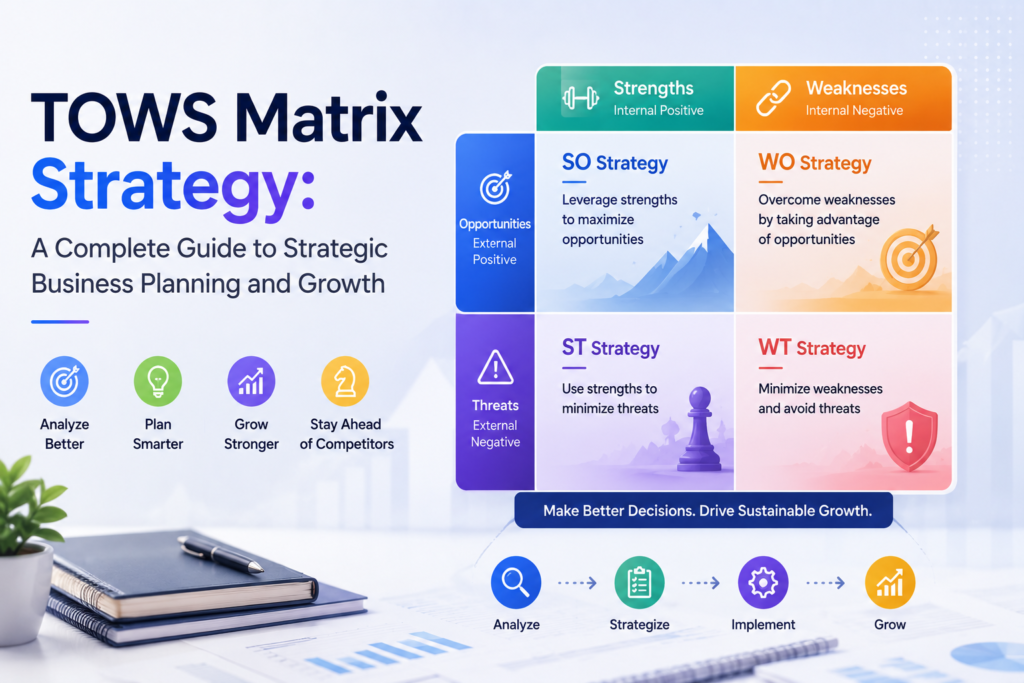
The TOWS Matrix combines internal and external factors to create four strategic approaches.
1. Strengths + Opportunities (SO Strategy)
This strategy focuses on using existing strengths to capitalize on external opportunities.
Examples include:
- Launching new products
- Entering emerging markets
- Expanding digital marketing campaigns
- Investing in innovation
Organizations should maximize competitive advantages whenever favorable opportunities exist.
2. Weaknesses + Opportunities (WO Strategy)
This approach identifies opportunities that can help overcome business weaknesses.
For example:
- Investing in employee training
- Adopting new technologies
- Forming strategic partnerships
- Improving customer experience
The objective is to strengthen internal capabilities while taking advantage of market opportunities.
3. Strengths + Threats (ST Strategy)
Businesses often face competitive pressure, changing regulations, or economic uncertainty.
An ST strategy uses organizational strengths to minimize external threats.
Examples include:
- Strengthening brand loyalty
- Increasing customer retention
- Expanding premium services
- Investing in product innovation
A strong competitive advantage often protects businesses from external challenges.
4. Weaknesses + Threats (WT Strategy)
This is a defensive strategy designed to minimize both weaknesses and risks.
Possible actions include:
- Reducing operational costs
- Improving internal processes
- Diversifying revenue sources
- Managing financial risks
Organizations use WT strategies to improve resilience during uncertain market conditions.
How to Build a TOWS Matrix
Developing a successful TOWS Matrix involves several steps.
Step 1: Identify Internal Strengths
Determine what your business does well.
Examples include:
- Strong brand reputation
- Skilled workforce
- Advanced technology
- Loyal customers
- Efficient operations
Step 2: Identify Internal Weaknesses
Evaluate areas that require improvement.
Examples include:
- Limited marketing budget
- Outdated systems
- Low brand awareness
- High operational costs
- Skill gaps
Step 3: Analyze External Opportunities
Look for market conditions that support growth.
These may include:
- Emerging customer demand
- New technologies
- Industry growth
- Global expansion
- Digital transformation
Step 4: Identify External Threats
Recognize risks that could affect your business.
Common threats include:
- Economic downturns
- New competitors
- Regulatory changes
- Changing customer preferences
- Supply chain disruptions
Step 5: Develop Strategic Actions
Combine the four factors to build practical strategies that support long-term business goals.
The result should be a clear roadmap for growth and risk management.
Benefits of Using the TOWS Matrix
Organizations across industries use the TOWS Matrix because it delivers measurable strategic value.
Better Decision-Making
Business leaders gain a complete understanding of both internal capabilities and market conditions before making strategic decisions.
Improved Strategic Planning
The framework helps organizations prioritize initiatives based on real business opportunities and risks.
Stronger Competitive Advantage
Businesses can use their unique strengths to outperform competitors while addressing internal limitations.
Effective Risk Management
Identifying potential threats early enables organizations to prepare proactive solutions rather than reacting to problems later.
Sustainable Business Growth
Long-term success depends on aligning business resources with changing market conditions.
The TOWS Matrix provides a structured roadmap for sustainable growth.
Real-World Example: Applying the TOWS Matrix
Imagine a technology company with:
Strengths
- Strong brand reputation
- Innovative products
- High customer satisfaction
Weaknesses
- Premium pricing
- Limited product categories
Opportunities
- Growing global demand
- Expansion into new markets
- AI-powered technologies
Threats
- Increasing competition
- Rapid technological changes
- Economic uncertainty
Using the TOWS Matrix, the company could:
- Launch affordable product lines.
- Expand into international markets.
- Invest in artificial intelligence.
- Build strategic partnerships.
- Improve operational efficiency.
By aligning strengths with opportunities while minimizing weaknesses and threats, the company creates a balanced long-term strategy.
Best Practices for Effective TOWS Analysis
To maximize the value of your analysis, follow these best practices.
Use Accurate Business Data
Reliable market research and internal performance metrics improve strategic planning.
Involve Cross-Functional Teams
Include leaders from marketing, sales, finance, operations, and customer service to gain diverse perspectives.
Prioritize Strategic Objectives
Not every opportunity deserves immediate investment.
Focus on initiatives that generate the highest long-term value.
Review Regularly
Business environments change rapidly.
Update your TOWS Matrix every six to twelve months or whenever significant market changes occur.
Turn Insights into Action
The TOWS Matrix should lead to measurable action plans with clear responsibilities and timelines.
Our Approach: Strategic Planning That Delivers Results
At 8 Views, we believe strategy should lead to measurable business outcomes—not just reports and presentations.
We use the TOWS Matrix Strategy alongside data-driven market research, competitor analysis, and digital marketing insights to develop customized growth strategies for businesses across industries.
By evaluating internal strengths, identifying improvement areas, and analyzing market opportunities, we create practical action plans that help businesses improve performance, strengthen brand positioning, and achieve sustainable growth.
Our strategic approach ensures every recommendation aligns with your business objectives while delivering measurable results.
Conclusion
The TOWS Matrix is more than a business analysis framework—it’s a strategic planning tool that helps organizations transform insights into action.
By combining internal strengths and weaknesses with external opportunities and threats, businesses can make informed decisions, reduce risks, and uncover new growth opportunities.
Whether you’re launching a startup, expanding an established company, or refining your business strategy, the TOWS Matrix provides a structured roadmap for long-term success.
Organizations that regularly evaluate their strategic position and adapt to changing market conditions are better equipped to remain competitive and achieve sustainable growth.
Frequently Asked Questions (FAQs)
1. What is the TOWS Matrix?
The TOWS Matrix is a strategic planning framework that combines strengths, weaknesses, opportunities, and threats to develop actionable business strategies.
2. How is the TOWS Matrix different from SWOT Analysis?
SWOT identifies business factors, while the TOWS Matrix uses those factors to create practical strategies and action plans.
3. Who should use the TOWS Matrix?
The TOWS Matrix is suitable for startups, small businesses, large enterprises, non-profit organizations, and government institutions seeking better strategic planning.
4. What are the four strategies in the TOWS Matrix?
The four strategies are:
- Strengths–Opportunities (SO)
- Weaknesses–Opportunities (WO)
- Strengths–Threats (ST)
- Weaknesses–Threats (WT)
5. How often should a TOWS Matrix be updated?
Businesses should review and update their TOWS Matrix every 6–12 months or whenever major market, customer, or competitive changes occur.
6. Why is the TOWS Matrix important for business growth?
It helps organizations make informed decisions, improve strategic planning, reduce risks, identify growth opportunities, and build a sustainable competitive advantage.